Building Mira: a voice front-desk in 48 hours
A weekend rabbit hole. Switching mid-build from LiveKit + Deepgram + Cartesia to Tavus CVI, the seven booking tools, and the bugs that taught me the system.
Spent a weekend on a question I’d been sitting on for a while: how hard is it actually to ship a voice AI front-desk for a clinic? Not a demo, a thing that books appointments, handles edge cases, and doesn’t sound stupid. I gave myself 48 hours and a list: voice in, voice out, a talking avatar, seven booking tools, a post-call summary, a clean UI.
Default stack everyone reaches for is LiveKit Agents for transport, Deepgram for STT, Cartesia for TTS, Tavus for the avatar, an LLM for the brain.
I built that stack. Then I threw most of it away.
Both repos are public and the live URL is at the bottom if you want to poke at it.
The first 12 hours: building the obvious stack
I started where most tutorials point. A LiveKit Agents Python worker handled the call lifecycle. Deepgram nova-3 did STT with server-side endpointing (because Silero VAD couldn’t keep up on Render’s free 0.1-CPU dyno, and that lesson cost me an evening). Cartesia did TTS with the sonic-english model. Gemini 2.5 Flash was the LLM. The “talking avatar” requirement got an amplitude-driven SVG portrait. A Web Audio AnalyserNode read RMS from the agent’s audio track and mapped it to a mouth aperture on an SVG ellipse. Not phoneme-perfect, but it read as “talking” without needing a paid avatar service.
It worked. End-to-end. Deployed to Render’s free tier with a single web process running both the LiveKit worker and the FastAPI summary endpoint (free tier doesn’t include background workers, so collapsing both into one process via a start.sh was the only way). Supabase Postgres for state. The whole thing.
Then I looked at it and thought: this is four vendors doing one job.
The pivot
Tavus CVI (Conversational Video Interface) collapses STT, LLM, TTS, and a real talking head into a single integration. You POST /v2/conversations with a persona ID and a replica ID, and you get back a conversation_url that’s a Daily.co room. Your browser joins the room, the replica joins a few seconds later, and they talk.
Felt uncomfortable. Like I was cheating. But what I actually wanted was voice in/out, tool calling, a database, and a smooth conversation. Not a specific list of vendors. Picking the simpler integration was the honest answer.
So I switched. Git history walks through it: c41b3d1 switch to tavus. About eight hours of work disappeared into a single commit, and the codebase shrank by half.
What I bought:
- One integration instead of four. Fewer failure modes, less glue.
- Sub-3s latency out of the box. The multi-vendor stack needed manual tuning of Deepgram endpointing and Cartesia streaming to hit the same target.
- Real lip-sync on the Phoenix-4 model. The amplitude-driven SVG portrait went in the bin.
What I gave up:
- Per-call control over STT/LLM/TTS. Tavus picks. Production at scale would want to swap providers per call by language or cost.
- Server-side tool execution. Tavus’s recommended pattern is frontend dispatch via Daily app-messages, which is great for latency and bad for observability.
More on the second one below.
How tool calling actually works in this stack
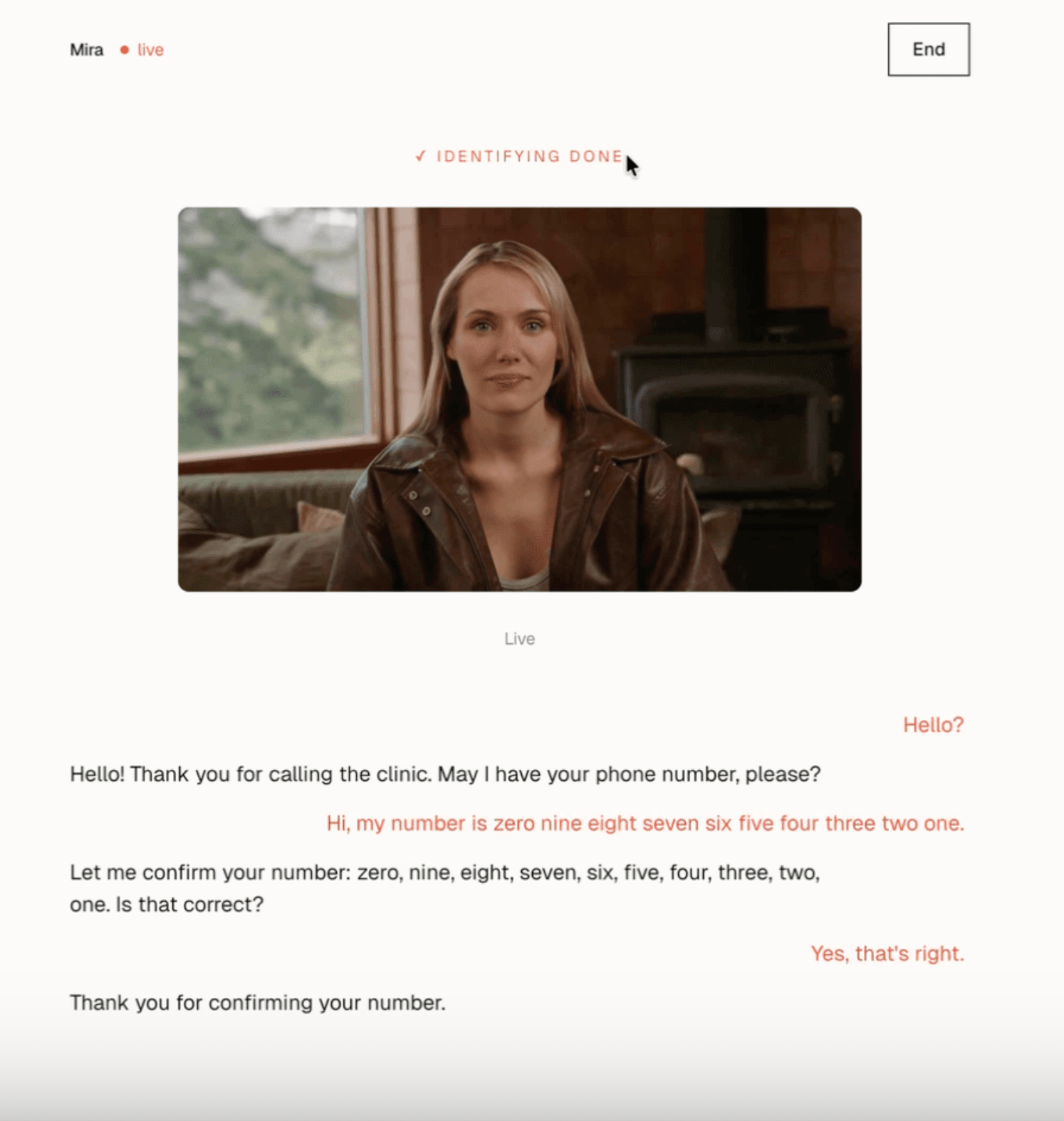
Tavus’s documentation says explicitly: Tavus does not execute tool calls on the backend. When the LLM decides to call book_appointment, it broadcasts a conversation.tool_call event into the Daily room as an app-message:
{
  "message_type": "conversation",
  "event_type": "conversation.tool_call",
  "conversation_id": "c123…",
  "properties": {
    "name": "book_appointment",
    "arguments": "{\"phone\":\"0987654321\",\"slot\":\"2026-05-02T14:00\"}"
  }
}
Your frontend listens for that event, executes the function (in our case by POSTing to a backend endpoint), and broadcasts the result back as a conversation.respond Daily message. Tavus’s LLM treats the result as if the user had spoken it, and generates the next reply.
This places the entire tool-execution layer on the client. The backend exists to:
- Open and close Tavus conversations.
- Run the seven tool functions (each is a pure function over Postgres).
- Persist transcript turns.
- Generate a Gemini summary at the end.
The actual /tools/{name} endpoint is twenty lines:
_TOOL_FNS = {
    "identify_user": lambda a, c: T.identify_user(a.get("phone", ""), a.get("name")),
    "fetch_slots": lambda a, c: T.fetch_slots(a.get("date")),
    "book_appointment": lambda a, c: T.book_appointment(a.get("phone", ""), a.get("slot", "")),
    "retrieve_appointments": lambda a, c: T.retrieve_appointments(a.get("phone", "")),
    "cancel_appointment": lambda a, c: T.cancel_appointment(int(a.get("appointment_id", 0))),
    "modify_appointment": lambda a, c: T.modify_appointment(int(a.get("appointment_id", 0)), a.get("new_slot", "")),
    "end_conversation": lambda a, c: T.end_conversation(c or ""),
}

@app.post("/tools/{name}")
def run_tool(name: str, payload: ToolPayload) -> dict:
    fn = _TOOL_FNS.get(name)
    if fn is None:
        raise HTTPException(404, f"unknown tool: {name}")
    try:
        result = fn(payload.args, payload.conversation_id)
    except Exception as e:
        log.exception(f"tool {name} failed")
        result = {"ok": False, "error": str(e)}
    return {"name": name, "result": result}
The dispatch table maps tool names to lambdas with a uniform (args, conversation_id) -> dict signature. end_conversation lives in the same table even though it doesn’t use args. Uniformity beats special cases.
Each tool in tools.py is a pure function. No HTTP, no Tavus, just Postgres. Ten unit tests run in 300 ms with DATABASE_URL=sqlite:///:memory:. Production goes through the same functions; only the wrapper changes.
The seven tools, with their guards
| Tool | Returns ok: false when | Reason |
|---|---|---|
identify_user | phone has fewer than 7 digits | obvious user error |
fetch_slots | date string isn’t YYYY-MM-DD | LLM hallucinated the format |
book_appointment | slot is already confirmed | double-book prevention |
book_appointment | phone never went through identify_user | belt to the system prompt’s braces |
cancel_appointment | appointment ID doesn’t exist | LLM made up an ID |
cancel_appointment | appointment is already cancelled | idempotency at the LLM level |
modify_appointment | new slot belongs to another confirmed appointment | clash prevention |
modify_appointment | trying to modify a cancelled appointment | state machine guard |
Every guard returns a string error code. The LLM is told (via the system prompt) how to recover from ok: false. In practice, when Mira gets ok: false, error: slot_taken, she says “Oh, that 11 a.m. slot is already booked. How about 10 or 2?” Natural recovery, no script.
The directive prefix problem
Here’s a bug that taught me the most about how conversation.respond actually works.
The first version of my tool-result echo sent the raw JSON:
sendRespond(`Tool ${name} returned: ${JSON.stringify(result)}`);Mira would then read this out loud in her speaking voice. As in, the user would hear: “Tool identify user returned colon open brace ok colon false comma error colon phone too short close brace.” Insane.
The fix has three parts:
- Prefix every tool-result echo with
[tool_result]. - Tell Mira in the system prompt to never read
[tool_result]lines aloud. - Filter any utterance containing
[tool_result]out of the visible transcript (Tavus emits aconversation.utteranceevent for ourrespondtext, which would otherwise appear in the chat panel as the user saying it).
Belt and braces and a third thing. Without all three, the experience falls apart.
![Live transcript panel: only the user's words and Mira's spoken replies, with [tool_result] echoes filtered out](/images/blogs/voice-agent/chat.png)
The current echo includes a directive sentence so the LLM knows what to do with the data:
sendRespond(
  `${TOOL_PREFIX} The ${name} tool returned: ${JSON.stringify(result)}. ` +
  `Use this data in your next reply. If it lists appointments, read them aloud. ` +
  `If ok is false, recover gracefully.`
);
The naked JSON wasn’t enough. The LLM kept getting confused and saying things like “no appointments on file” when the JSON clearly listed two. Adding the imperative sentence fixed it.
Other bugs worth listing
These are the ones that would have stayed bugs if I hadn’t watched real calls. The git history has a commit for each.
| Symptom | Root cause | Fix |
|---|---|---|
Render dyno wouldn’t bind $PORT | init_db() threw because Supabase was unreachable; uvicorn never started | Wrap init_db in try/except |
/health returned 405 to UptimeRobot | @app.get doesn’t auto-route HEAD; UptimeRobot pings HEAD by default | @app.api_route("/health", methods=["GET", "HEAD"]) |
| Every utterance recorded twice | Both Tavus webhook AND frontend posted to /transcript | Made /tavus/event a no-op; frontend is sole source |
| Daily threw “token should be a string” | Backend returned meeting_token: null; we passed it to daily.join() | Conditionally include the token only if truthy |
| Replica’s video didn’t show | Wrong participant filter + <DailyVideo> inside a circular orb | Filter by tavus-replica user_id; switch to plain rectangular tile |
| Mira ended the call after asking a question | LLM jumped to end_conversation without waiting for a reply | Tighten the system prompt: “DO NOT call end_conversation until the caller explicitly says they’re done” |
| Mira didn’t confirm phone digit-by-digit | First version trusted STT | System prompt now requires read-back-and-wait-for-yes before identify_user |
The LLM does what the system prompt tells it to. Every misbehaviour I caught was a missing sentence.
Render free-tier notes
Three things that cost me an hour each.
The free dyno sleeps after 15 minutes idle and cold-starts in 30–90 seconds. The landing page fires a GET /health on mount via a tiny <Warmup /> component, so by the time the user clicks Start the dyno’s awake. UptimeRobot pinging /health every 5 minutes is the production-grade version.
Render free tier has no outbound IPv6, and Supabase’s direct host resolves to IPv6 only. Fix: use Supabase’s Session pooler at aws-1-<region>.pooler.supabase.com:5432. This is documented in .env.example so the next person doesn’t lose 90 minutes the way I did.
The 512 MB memory cap killed my LiveKit Agents stack under default subprocess prewarming. JobExecutorType.THREAD, num_idle_processes=0 fixed it. The Tavus version doesn’t run a worker on our side, so the cap stopped mattering after the pivot.
What it costs to run
Per-call cost is duration_minutes × TAVUS_RATE_USD_PER_MIN (default 0.15). Gemini summaries are effectively free at this volume (a 60-second call’s transcript is under 1k tokens).
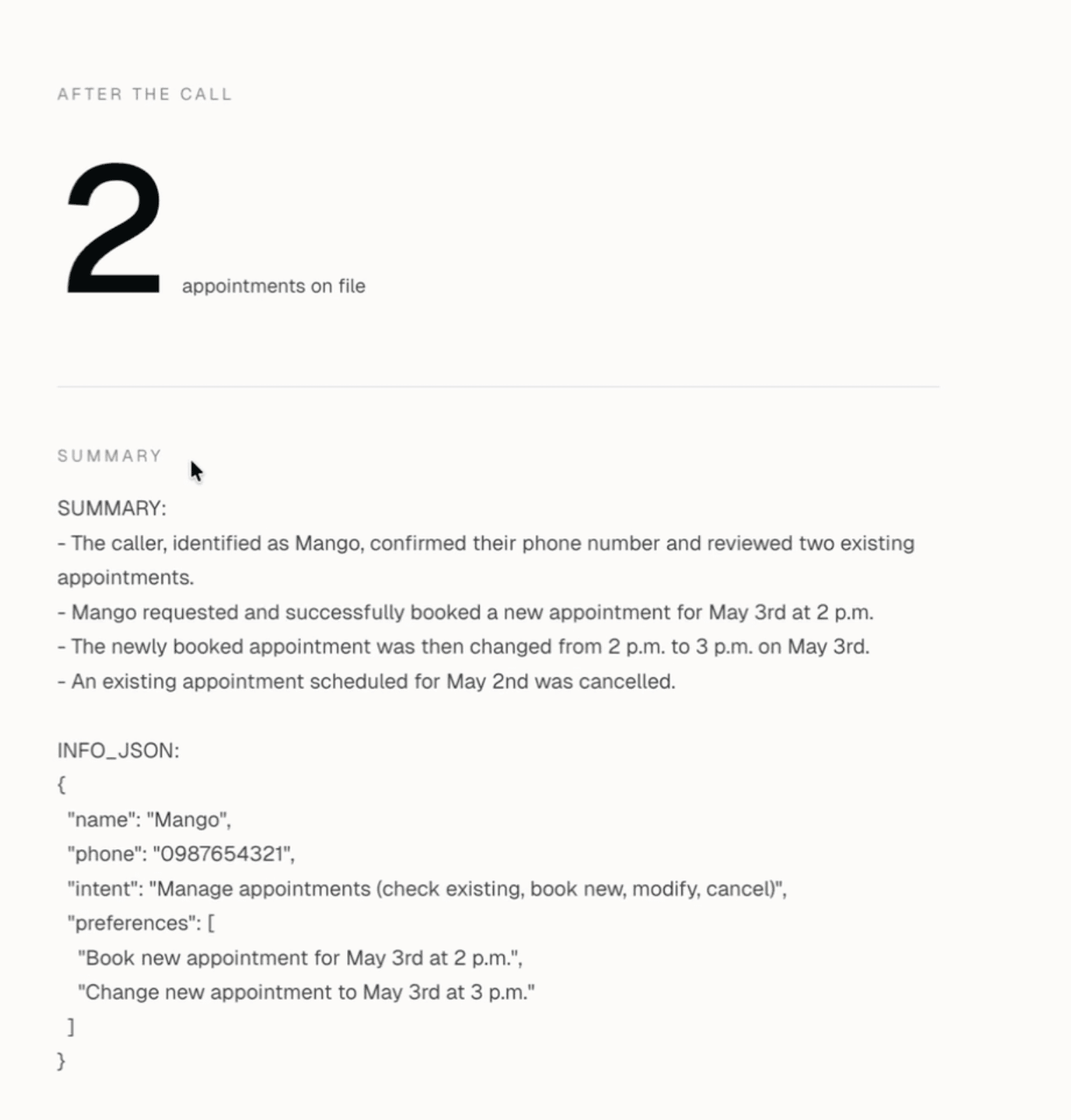
A 90-second call comes out to ~$0.225 USD or about ₹19. The free Tavus tier is 25 minutes per month, roughly 16 calls. The summary card shows both USD and INR, with USD_TO_INR as an env var so the rate updates without a redeploy.
At weekend volumes that math is fine. At anything resembling production volume the Tavus per-minute would dominate, which is why most of what comes next is about owning more of the pipeline.
What I’d change for production
In rough priority order.
- Move tool dispatch server-side. Right now the browser is the source of truth for what tools ran and what they returned, which is fine for a demo and bad for everything else. Server-side dispatch buys you a real audit trail, observability, and a way to reject a malicious client claiming
book_appointmentsucceeded when it didn’t. - Idempotency keys on tool POSTs. If the frontend retries
book_appointment, theslot_takenguard catches the second write, but only because of the unique slot index. An explicit idempotency key is safer and would also de-dupe accidental double-clicks on the frontend. - HMAC-verify the Tavus webhook.
/tavus/eventis a no-op sink today, so the security surface is zero, but if I started using the webhook I’d want HMAC verification per Tavus docs before trusting any of it. - Own the STT/LLM/TTS pipeline. Keep Tavus for the avatar only. Swapping providers per call by cost, language, or latency only happens if you control the orchestration. This is the largest rewrite of the four and the only one that pays back at scale.
Where it lives
- Backend repo: github.com/1Mangesh1/voice-agent-demo-backend
- Frontend repo: github.com/1Mangesh1/voice-agent-demo-frontend
- Live: voice-agent-demo-frontend.vercel.app
- Backend health: voice-agent-demo-api.onrender.com/health
Both READMEs are written like a person wrote them, because one did. Each repo has a “what’s not implemented (and why)” section, which I find more useful than the usual feature list.
If I poked at this another weekend I’d move tool dispatch to the backend and wire OpenTelemetry through the call lifecycle. Given a full week I’d build a small Tavus replacement (LiveKit + Deepgram + Cartesia + a self-hosted lipsync model) and watch the cost-per-minute drop by 5×.
The companion post, Tavus CVI + Daily React: hands-on with tool calling, goes deeper into the wire format. Read that one if you want to build something like this yourself.
Related Posts
Tavus CVI + Daily React: hands-on with tool calling
What actually happens when an AI replica calls a function on the wire: Daily app-messages, conversation.respond, the [tool_result] convention, and why <DailyVideo> beats raw <video>.
Cloudflare Bought My Framework, So I Audited My Whole Stack
Cloudflare acquired Astro in January 2026. My site is Astro on GitHub Pages, behind Cloudflare DNS, with a Cloudflare Worker running its AI chat. An audit of what the acquisition and Astro 6 actually change for a real site, and why I'm not migrating yet.
My Claude Code Setup: Rule Files, Memory Plugins, and Two Personalities
A tour of my actual Claude Code configuration: layered CLAUDE.md rule files, a lazy-senior-dev mode called ponytail, a token-saving caveman mode, persistent memory plugins, and the skills that enforce discipline. With honest notes on what actually matters.